

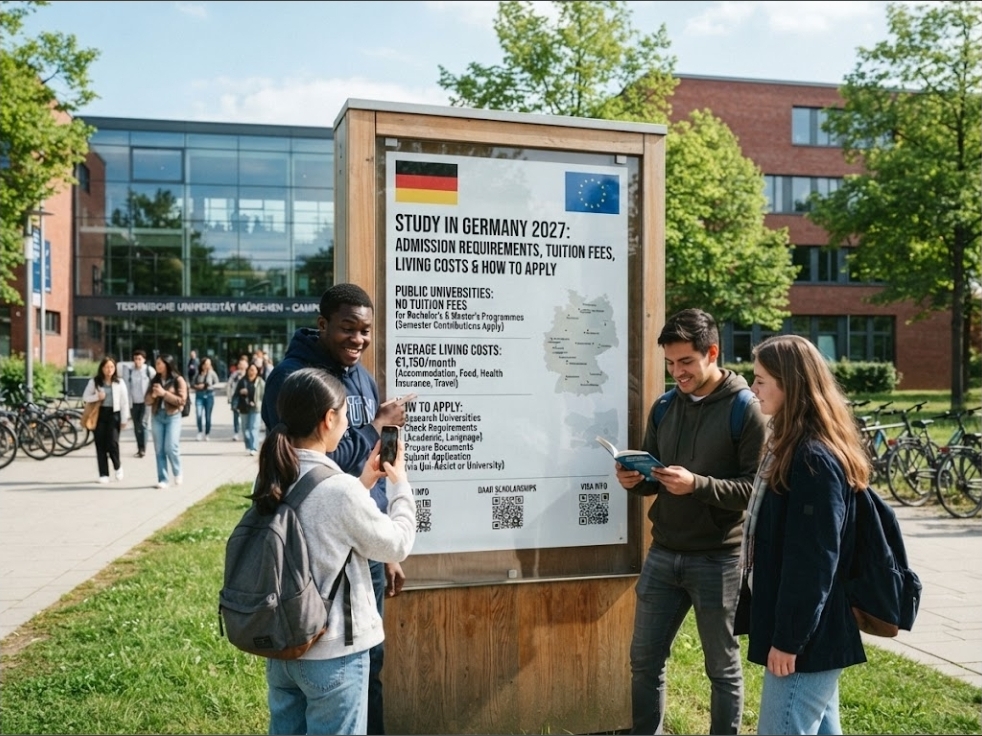
Germany remains one of Europe’s popular destinations for international students seeking quality higher education, internationally recognised qualifications and opportunities to build successful careers.
The country offers a wide range of undergraduate, postgraduate and doctoral programmes across different academic disciplines. International students can choose from research universities, universities of applied sciences and specialised institutions for arts, music and film.
One of the major attractions of studying in Germany is that most public universities do not charge tuition fees for bachelor’s degrees and many master’s programmes. However, students should understand that tuition-free education does not mean studying in Germany is completely free, as accommodation, food, transportation, health insurance and other living expenses must still be covered.
According to the European Commission’s Study in Europe information, international students in Germany spend an average of approximately €1,150 per month on living expenses.
Students from countries outside the European Union and European Economic Area, including Nigeria, can apply to German universities, provided they meet the relevant academic, language and visa requirements.
This guide explains how to study in Germany, the available degree programmes, tuition fees, living expenses, scholarships, admission requirements and application procedures.
Why Study in Germany?
Germany offers several advantages to international students looking to pursue higher education in Europe.
Some of the reasons students choose Germany include:
1. Affordable Public University Education
Most public universities in Germany do not charge tuition fees for bachelor’s programmes and many master’s programmes.
This makes Germany an attractive destination for students who want to obtain internationally recognised qualifications without paying the high tuition fees charged by some other study destinations.
2. Internationally Recognised Qualifications
German universities offer academic programmes recognised internationally, providing graduates with qualifications that can support further education and career opportunities.
3. English-Taught Degree Programmes
Although German is the country’s main language, many universities offer degree programmes entirely in English.
International students who do not speak German can therefore find suitable programmes, particularly at postgraduate level.
4. Different Academic Programmes
Germany offers opportunities across engineering, medicine, business, technology, natural sciences, social sciences, arts and other disciplines.
5. Opportunities to Work While Studying
International students are permitted to work alongside their studies, subject to the applicable immigration and employment regulations.
6. Diverse International Student Community
Students from different countries study in Germany, creating opportunities to interact with people from different cultures and backgrounds.
Types of Higher Education Institutions in Germany
Germany has different categories of higher education institutions, each offering specific academic and professional opportunities.
Before applying, international students should understand the differences between them.
1. Research Universities
Research universities focus on academic education, scientific research and theoretical knowledge.
They offer undergraduate and postgraduate programmes and provide opportunities for students interested in academic research and doctoral studies.
2. Universities of Applied Sciences
Universities of applied sciences place greater emphasis on practical education, professional skills and industry-related training.
They are suitable for students who want to combine academic knowledge with practical experience.
3. Schools of Art, Film and Music
These institutions specialise in creative disciplines, including visual arts, music, film and other artistic programmes.
International students can apply for different academic qualifications depending on their previous education and career goals.
The major degree options include:
Admission may involve additional requirements such as portfolios, auditions or practical assessments.
Degree Programmes Available in Germany
| Degree | Typical duration |
|---|---|
| Bachelor’s degree | 3–4 years |
| Master’s degree | 1–2 years |
| Doctorate | 3–5 years |
| State Examination | Often 4–6 years |
| Diplom and Magister Artium | 4–6 years |
Germany also provides opportunities for international exchange programmes, short-term academic studies, Erasmus+ programmes and summer schools.
Read Also: University Of Twente Scholarship 2027 In The Netherlands: Apply For Up To €22,000
Tuition Fees for International Students in Germany
One of the biggest advantages of studying in Germany is the availability of tuition-free programmes at public universities.
Most state universities do not charge tuition fees for bachelor’s degrees and many master’s programmes.
However, there are important exceptions students should understand before applying.
1. Public Universities
Many public universities offer tuition-free bachelor’s and master’s programmes.
However, students are generally required to pay semester contributions covering services such as student administration, student facilities and, in some cases, transportation benefits.
2. Private Universities
Private universities generally charge tuition fees, and the costs can be considerably higher than those of public institutions.
Students should check the tuition requirements of their chosen university before applying.
3. Second Degrees and Extended Studies
Some German states charge tuition fees for students pursuing a second degree or those who take longer than the permitted period to complete their studies.
4. Special Master’s Programmes
Some specialised master’s and online programmes charge significant tuition fees.
According to the European Commission, certain programmes may cost more than €10,000 per semester.
Therefore, applicants should not assume that every university or programme in Germany is tuition-free.
Cost of Living in Germany for International Students
Although many public universities do not charge tuition fees, international students must have sufficient funds to cover their living expenses.
The European Commission estimates that students in Germany spend an average of approximately €1,150 per month.
This amount covers essential expenses such as:
- Accommodation and rent.
- Food and groceries.
- Transportation.
- Health insurance.
- Personal expenses.
- Study materials and other necessities.
The actual amount depends on the city, accommodation arrangement and individual lifestyle.
Students living in expensive cities may spend more, while those studying in smaller towns may find more affordable accommodation.
It is advisable to prepare a realistic financial plan before travelling to Germany.
Scholarships Available for International Students in Germany
International students who need financial assistance can explore scholarship opportunities offered by German organisations, universities and other funding institutions.
One important source of funding is the German Academic Exchange Service (DAAD).
DAAD provides scholarship opportunities for German and international students, including undergraduate and postgraduate students, as well as researchers.
Scholarship opportunities vary according to academic level, nationality, field of study and programme requirements.
However, students should understand that obtaining a scholarship can be competitive.
Full funding for an entire study programme is relatively uncommon, and many scholarships are not available to students who are just beginning their studies.
Interested applicants can search for available opportunities through the official DAAD scholarship database: https://www.daad.de/en/studying-in-germany/scholarships
Students should also check the scholarship pages of their chosen universities for additional funding opportunities.
Admission Requirements for International Students in Germany
Admission requirements vary depending on the university, academic programme and applicant’s country of origin.
However, international students should prepare for the following requirements.
1. Recognised Academic Qualifications
Applicants must possess educational qualifications that meet the admission requirements of their chosen programme.
For undergraduate admission, students need a recognised university entrance qualification.
For master’s programmes, applicants generally need a relevant bachelor’s degree or equivalent qualification.
2. Academic Transcripts and Certificates
Candidates should prepare their academic records, including:
- Secondary school certificates.
- University transcripts, where applicable.
- Previous degree certificates.
- Other academic qualifications requested by the university.
Documents may need to be certified or translated depending on the institution’s requirements.
3. Language Proficiency
Students applying for German-taught programmes may be required to demonstrate proficiency in German.
Applicants to English-taught programmes may need to provide an accepted English language certificate, depending on the university.
Commonly accepted English language examinations include IELTS and TOEFL, although requirements differ between institutions.
4. Valid International Passport
Applicants from outside the EU/EEA should have a valid passport for the application and visa process.
5. Additional Programme Requirements
Some programmes may require additional documents, such as motivation letters, portfolios, recommendation letters or proof of relevant academic experience.
Applicants should carefully review the requirements of their chosen universities.
How to Apply for Admission to a German University
International students interested in studying in Germany must complete the admission process established by their chosen institution.
The application process generally involves the following steps.
Step 1: Choose Your Preferred University and Programme
Research German universities and identify a degree programme that matches your academic background and career interests.
Check whether the programme is taught in English or German.
Step 2: Check the Admission Requirements
Visit the university’s official website and review the entry requirements for international applicants.
Check whether your previous qualifications are recognised and whether additional examinations or language certificates are required.
Step 3: Prepare Your Documents
Gather the required application documents, including:
- Academic certificates.
- Academic transcripts.
- Passport copy.
- Passport photograph.
- English or German language certificate.
- Motivation letter, if required.
- Other supporting documents requested by the university.
Step 4: Find Out How to Submit Your Application
German universities use different application systems.
Depending on the institution and programme, applications may be submitted through:
- The university’s international admissions office.
- Uni-assist, the application service for international students.
- Hochschulstart, the University Admissions Foundation, for programmes handled through its centralised system.
Not every university uses the same application platform.
Step 5: Submit Your Application
Complete the application form and upload the required documents.
Where applicable, pay the relevant application processing fee.
For example, uni-assist charges €75 for the first application and €15 for each additional application within the same semester, according to the European Commission’s information.
Step 6: Wait for the Admission Decision
After submitting your application, monitor your email and university application account for updates.
If admitted, follow the institution’s instructions for accepting your place and completing enrolment.
Step 7: Apply for a German Student Visa
Non-EU/EEA students generally need a visa to study in Germany.
Students should begin the visa process early and follow the requirements of the German embassy or consulate responsible for their country.
Germany Student Visa Requirements for International Students
Students from outside the European Union and European Economic Area, including Nigerian applicants, generally need a visa before travelling to Germany for their studies.
There are two main visa categories relevant to prospective students.
1. Student Visa
This visa is intended for applicants who have already received admission to a German university.
Candidates should apply before travelling to Germany.
2. Prospective Student Visa
This visa is intended for individuals who have not yet secured university admission but want to travel to Germany to pursue their admission process.
According to the European Commission, this visa is initially valid for three months and can be extended for up to six months.
Applicants should consult the German diplomatic mission responsible for their country for the latest visa requirements and supporting documents.
Can International Students Work While Studying in Germany?
Yes. International students are permitted to work while studying in Germany, subject to the applicable regulations.
For non-EU/EEA students, the general employment allowance is:
- Up to 140 full working days per year.
- Up to 280 half working days per year.
- Alternatively, up to 20 hours per week.
Students who want to work beyond the permitted limits generally need special permission from the employment agency and immigration office.
Self-employment is not permitted under the standard student employment rules described in the European Commission’s guide.
Students should ensure that their employment does not interfere with their academic responsibilities.
Health Insurance Requirements for International Students
Health insurance is compulsory for international students studying in Germany.
Students must provide proof of health insurance when enrolling at a higher education institution and applying for a residence permit.
Depending on their country of origin and insurance arrangements, some students may be able to use existing insurance coverage, while others will need to obtain German health insurance.
Applicants should confirm that their insurance meets the requirements before travelling.
Accommodation in Germany for International Students
Finding suitable accommodation is another important part of preparing to study in Germany.
Students are encouraged to begin their housing search early because accommodation can be competitive in popular university cities.
Some available accommodation options include:
1. Student Dormitories
University student residences are often among the more affordable accommodation options.
Students should contact their university’s international office or student services department to find out how to apply.
2. Shared Apartments
International students can also rent rooms in shared apartments with other students.
This can help reduce accommodation expenses.
3. Private Accommodation
Private apartments and rooms are available in different German cities, although costs vary depending on location and property type.
Important: Be careful when searching for accommodation online. Avoid sending money to unknown individuals before verifying the property and rental arrangements.
Student Life in Germany
Germany offers international students an opportunity to experience a diverse academic and cultural environment.
Universities provide different support services to help international students adjust to life in the country.
These services may include assistance with accommodation, administrative matters, legal information and student activities.
Students can also participate in cultural events, university organisations, sports activities and social programmes.
Learning some basic German can make everyday activities easier, even when studying in an English-taught programme.
Frequently Asked Questions About Studying in Germany
1. Can Nigerian students study in Germany?
Yes. Nigerian students can apply to German universities if they meet the academic, language and admission requirements of their chosen programmes.
2. Is university education free in Germany?
Most public universities do not charge tuition fees for bachelor’s programmes and many master’s programmes. However, some institutions and programmes charge tuition fees, and students must still cover living expenses and other costs.
3. How much does it cost to live in Germany as a student?
The European Commission estimates that students spend an average of approximately €1,150 per month on living expenses. Actual costs depend on the city and lifestyle.
4. Can I study in Germany without IELTS?
Some universities and programmes may accept alternative proof of English proficiency or previous education in English. However, applicants must check the specific language requirements of their chosen institutions.
5. Can I work while studying in Germany?
Yes. Non-EU/EEA students can generally work up to 140 full days or 280 half days per year, or up to 20 hours per week, subject to applicable regulations.
6. Are there scholarships for international students in Germany?
Yes. International students can explore funding opportunities offered by DAAD, universities and other scholarship organisations.
7. Do I need a visa to study in Germany?
Yes. Students from non-EU/EEA countries generally need a visa before travelling to Germany for their studies.
8. How long does it take to complete a degree in Germany?
A bachelor’s degree typically takes three to four years, while a master’s degree generally takes one to two years. Doctoral programmes usually take three to five years.
Final Note
Germany offers international students access to a wide range of academic programmes, research opportunities and internationally recognised qualifications.
With many public universities offering tuition-free bachelor’s and master’s programmes, the country can be an attractive destination for students seeking affordable higher education in Europe.
However, prospective students should remember that tuition-free education does not eliminate the need for financial preparation. Accommodation, food, transportation, health insurance and visa requirements must all be considered before travelling.
Nigerian students interested in studying in Germany should begin researching suitable universities, confirm whether their qualifications are recognised, prepare their academic documents and explore available scholarship opportunities.
For more information, visit the official Study in Germany and European Commission education websites before submitting an application.
